Exploring how practical systems can help carry climate and biodiversity commitments through the life of a building.
The built environment is entering a period of profound change.
Across Australia and around the world, architects, manufacturers, asset owners and governments are rethinking how buildings are designed, constructed, maintained and eventually renewed. The challenges of climate change, biodiversity loss, resource consumption and social responsibility are encouraging all of us to look beyond individual projects and consider the wider systems that shape the places we create.
The Australian Architects Declare Climate & Biodiversity Emergency Declaration and the 2026 Strategic Plan – Radical Care have become important contributions to that conversation. Together they invite our profession to think differently about the relationship between design, materials, collaboration, stewardship and the long-term care of both people and place.
Their work reminds us that responding to these challenges will require more than new technologies or different materials alone. It asks us to reconsider the relationships that exist throughout the life of a building and to recognise that every decision influences the generations that follow.
While reflecting on these ideas, we recognised something familiar.
For many years, we have been observing similar questions through our own work with architects, manufacturers, and custodians of the built environment. Conversations about accessibility often became conversations about stewardship. Discussions about materials frequently led to questions of recovery, maintenance and long-term responsibility. Projects continued revealing connections that reached well beyond the products themselves.
One observation continued returning.
Every system leaves evidence.
That simple observation has gradually become the foundation of the Staebl Framework.
Rather than beginning with products, we began asking what evidence systems leave behind and what those observations might teach us. Those questions eventually informed practical initiatives including the Design Loop®, Waste Remade®, Custodian®, Material Verification Statements and the Staebl Academy. While each initiative serves a different purpose, together they explore one continuing question:
how can architectural intent remain connected to the people who will inherit our buildings long after practical completion?
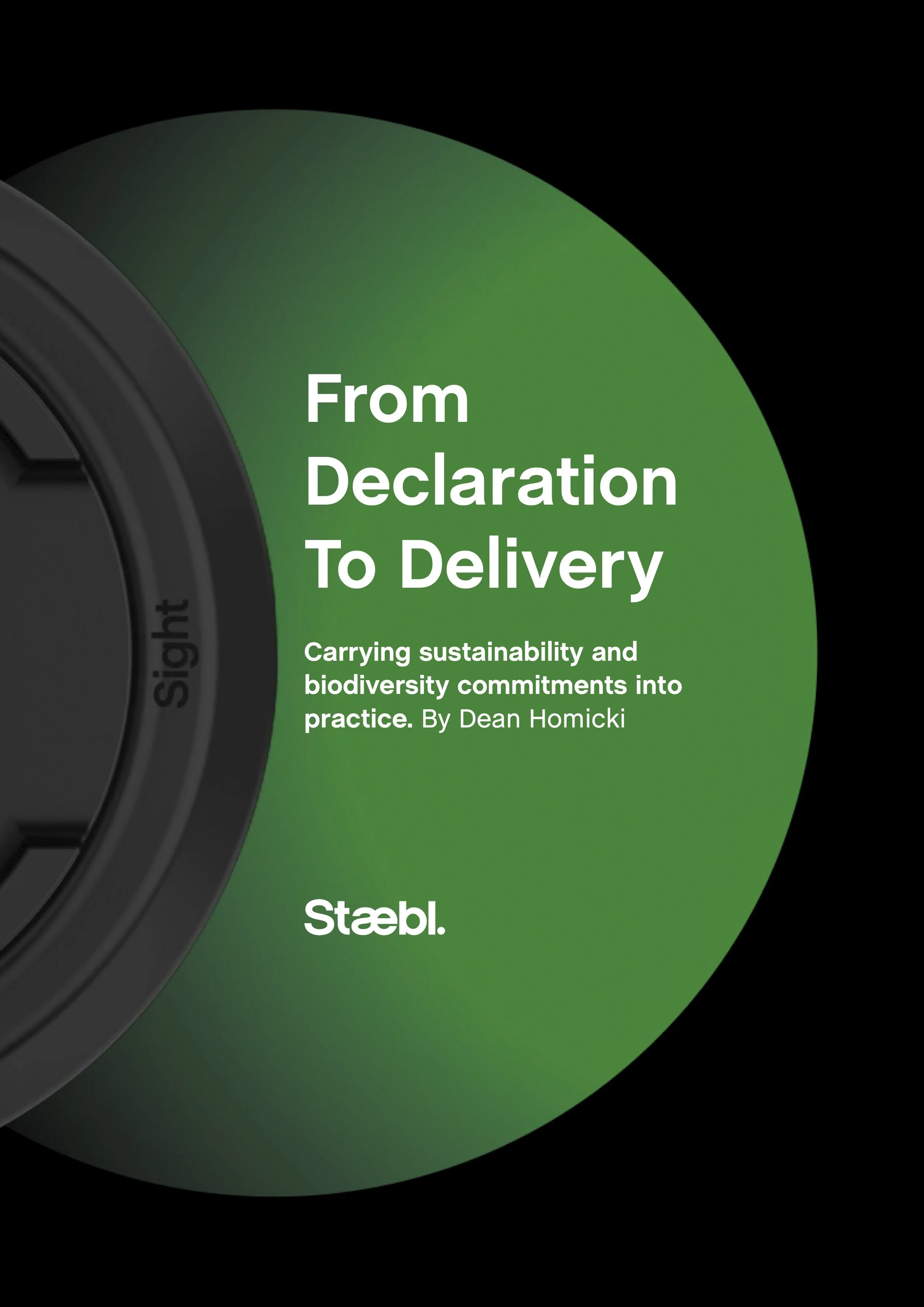
Those reflections became the basis of a discussion paper that Staebl has prepared titled From Declaration to Delivery.
Rather than responding to the Australian Architects Declare initiative with another declaration, the paper explores how many of the aspirations described within the Climate & Biodiversity Emergency Declaration and the 2026 Strategic Plan – Radical Care may be supported through practical systems that connect design, material verification, manufacturing, installation, maintenance, recovery and ongoing learning for everyone who comes into contact with it.
It is offered in a spirit of professional curiosity and collaboration. It does not seek to replace or reinterpret the work of Australian Architects Declare. Instead, it asks how manufacturers and others throughout the construction industry might contribute to carrying those aspirations forward throughout the life of a building.
If these conversations are of interest to you, we encourage you to begin by exploring the work of Australian Architects Declare. Their declaration and strategic plan provide valuable leadership for our profession and help frame many of the questions explored within our own discussion paper.
From there, if you are interested in one manufacturer's observations and the practical systems that have gradually emerged from them, we invite you to download From Declaration to Delivery and continue the conversation.
Australian Architects Declare
Learn more
Explore the Climate & Biodiversity Emergency Declaration, the 2026 Strategic Plan – Radical Care, and the broader work of Australian Architects Declare.
Download the discussion paper
Exploring how practical systems can help carry climate and biodiversity commitments through the life of a building.
Frequently Asked Questions
Continuing the Conversation
The following questions have been inspired by the themes explored within the Australian Architects Declare Climate & Biodiversity Emergency Declaration and the 2026 Strategic Plan – Radical Care, together with observations Staebl has made while working alongside architects, designers, manufacturers, builders, facility managers and custodians of the built environment.
-
The Australian Architects Declare Climate & Biodiversity Emergency Declaration and the 2026 Strategic Plan – Radical Care invite all of us involved in the built environment to think differently about the future of our profession. They encourage greater collaboration, stronger stewardship, and a deeper understanding of the relationship between buildings, communities and the natural world.
While reflecting on these ideas, Staebl recognised many of the same questions had been emerging through our own work over many years. Rather than writing another declaration, we chose to explore how practical systems can help carry those aspirations beyond design and into manufacturing, verification, installation, maintenance, recovery and ongoing learning.
Our discussion paper, From Declaration to Delivery, is offered as a contribution to that wider professional conversation.
Continue Learning
Download From Declaration to Delivery – staebl.com/from-declaration-to-delivery
Learn more about Australian Architects Declare – architectsdeclare.com.au
-
No. Australian Architects Declare is an independent movement led by architects. Staebl is an independent Australian manufacturer and educator.
Our discussion paper is inspired by the questions raised through the Declaration and the 2026 Strategic Plan – Radical Care. It reflects our own observations and explores how manufacturers and others throughout the construction industry can contribute to carrying those aspirations forward.
We encourage every reader to explore the Australian Architects Declare website and learn directly from their work.
Continue Learning
Australian Architects Declare – architectsdeclare.com.au
Download From Declaration to Delivery – staebl.com/from-declaration-to-delivery
-
Buildings are never created by products alone. They emerge through relationships between people, materials, decisions and responsibilities that continue long after practical completion. Products become one part of a much larger system involving design, procurement, manufacturing, installation, maintenance, compliance, recovery and future reuse.
Looking at systems first helps us understand how individual decisions influence everything that follows.
That observation led to one simple question.
What evidence has this system left behind, and what can we learn from it?
Continue Learning
The Staebl Framework – staebl.com/framework (NW)
Every System Leaves Evidence – future discussion paper.
-
Every decision leaves a trace. Some evidence can be seen immediately through the performance of a building. Other evidence appears years later through maintenance records, accessibility outcomes, recovered materials, operational performance or the experiences of people using the built environment.
Learning to recognise that evidence allows future projects to begin with greater understanding instead of repeating the same mistakes.
This observation became the foundation of the Staebl Framework.
Continue Learning
The Staebl Framework – staebl.com/framework (NN)
From Declaration to Delivery – staebl.com/from-declaration-to-delivery
-
Responding to climate change involves more than selecting lower-carbon materials. It also involves understanding where materials come from, how they are verified, how they perform throughout their lives, how they are maintained and whether they can continue creating value after their first application.
Looking across the whole life of a building often reveals opportunities that cannot be seen when products are considered in isolation.
Continue Learning
Waste Remade® – staebl.com/waste-remade
Material Verification Statements – staebl.com/material-verification
Design Loop® – staebl.com/design-loop
-
Trust grows when information can be understood and independently verified. Material Verification Statements were developed to provide greater transparency around recycled content, material origins and manufacturing processes. They help architects, designers and clients make informed decisions while strengthening confidence in environmental claims.
Verification is not simply about proving where materials have come from. It also helps establish a clearer understanding of where they may go in the future.
Continue Learning
Material Verification Statements – staebl.com/material-verification
Waste Remade® – staebl.com/waste-remade
-
Item descriptionThe Design Loop® is Staebl's approach to understanding the continuing relationship between design, manufacturing, installation, custodianship, maintenance, recovery and future reuse.
Rather than viewing a building product as the end of a manufacturing process, the Design Loop® considers how today's decisions can continue supporting future custodians and future projects.
It reflects the belief that good design should continue creating value throughout the life of a building.
Continue Learning
Design Loop® – staebl.com/design-loop
Trade-in & Reunion® – staebl.com/trade-in-and-reunion
Custodian® – staebl.com/custodian
-
Buildings often remain in service for many decades. During that time, responsibility passes from architects to builders, facility managers, maintenance teams, owners and future generations. Thinking in terms of custodians reminds us that every project becomes someone else's responsibility to care for.
This shift in language encourages us to think beyond transactions and towards long-term stewardship.
Continue Learning
Custodian® – staebl.com/custodian
Custodian Handbook – staebl.com/custodian-handbook
-
Accessible environments are environments that more people can continue using throughout changing stages of life. Places that remain inclusive, adaptable and valued are more likely to be maintained, upgraded and retained rather than replaced. (Better Placed | Planning, 2021) Many of the same principles that support long-term accessibility also encourage thoughtful stewardship, reduced waste and longer service life.
Accessibility and sustainability are often strengthened together when we begin by understanding people's lived experiences.
Continue Learning
Staebl Academy – staebl.com/academy
Accessibility Resources – staebl.com/resources
-
Many of the challenges facing the built environment are shared challenges. Knowledge creates its greatest value when it helps others make better decisions. The Staebl Academy exists to encourage learning, practical understanding and ongoing professional discussion across accessibility, sustainability, material stewardship and the built environment. (Staebl Academy - Mobility Access Design Library, 2023)
Learning has the greatest impact when it can continue beyond individual organisations and projects. (Benn et al., 2013, pp. 184-202)
Continue Learning
Staebl Academy – staebl.com/academy
Learning in Minutes – staebl.com/learning
-
Manufacturers influence far more than the products they supply. They make decisions about material selection, recycled content, verification, manufacturing processes, packaging, transport, durability, maintenance and recovery. These decisions affect the environmental performance of projects long before installation and long after practical completion.
Staebl believes manufacturers can contribute by developing systems that support architects, builders and custodians throughout the entire life of a building, rather than simply supplying products.
Continue Learning
Design Loop® – staebl.com/design-loop
Waste Remade® – staebl.com/waste-remade
Material Verification Statements – staebl.com/material-verification
-
No. The discussion paper reflects one ongoing exploration. The Australian Architects Declare initiative reminds us that responding to climate change and biodiversity loss will require continual learning, collaboration and adaptation. Every project, every material and every building adds to that understanding.
Our hope is that From Declaration to Delivery encourages readers to observe more carefully, ask thoughtful questions and continue contributing to a profession that is learning together.
Continue Learning
Download From Declaration to Delivery – staebl.com/from-declaration-to-delivery
Explore Australian Architects Declare – architectsdeclare.com.au
Visit the Staebl Framework – staebl.com/framework (NN)
Choose a product and view the related documents, environmental information and available downloads.
Specs, Manuals & Downloads